Why Julia Roberts’ presence still feels like an event
Even in 2026, when new content drops daily and celebrity culture feels saturated, Julia Roberts walking onto a screen or stepping onto a red carpet still registers as an event. At 58, she carries a gravitational pull that transcends fame. It is not loud or desperate for attention. It is the accumulated power of decades of authentic storytelling, combined with a rare, centered presence that makes everyone around her sit up a little straighter. Her work in Luca Guadagnino’s After the Hunt (2025) proves this once again. The psychological drama didn’t need blockbuster marketing or gimmicks—Roberts’ name alone turned it into a cultural moment.
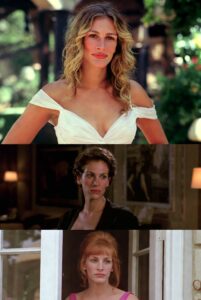
What makes her presence feel event-worthy is its rarity and reliability. Since Pretty Woman (1990), Roberts has understood that true stardom comes from making audiences feel something genuine. Vivian’s nervous excitement, Erin Brockovich’s righteous swagger, and now Professor Alma Imhoff’s quiet moral reckoning all share one trait: Roberts never hides behind the character. She inhabits it completely. In After the Hunt, her restrained performance—subtle shifts in expression, weighted silences, and moments of raw vulnerability—dominates the film without ever demanding the spotlight. The Venice Film Festival gave it a lengthy standing ovation. Critics called her work “magnetic” and “effortlessly commanding,” while audiences described leaving the theater feeling they had witnessed something important.
Roberts’ event status also stems from how selectively she appears. She does not flood the market. She does not chase trends or overexpose herself on social media. Each project feels intentional, like receiving a carefully chosen gift rather than constant noise. This scarcity increases value. When she does show up—whether in a romantic comedy like Ticket to Paradise, a thriller like Leave the World Behind, or a prestige drama like After the Hunt—it feels special. Her chemistry with younger co-stars Ayo Edebiri and Andrew Garfield added generational electricity, yet Roberts remained the undeniable center, guiding scenes with the calm authority of someone who has nothing left to prove.
Off-screen, her life reinforces this aura. A stable marriage to Danny Moder since 2002, three grounded children, and a deliberate embrace of privacy and normalcy give her an unshakable core. She speaks about aging with humor and acceptance, finding joy in gardening, family meals, and intellectual curiosity. This wholeness radiates. There is no frantic reinvention, no manufactured drama. Her elegance is quiet, her confidence earned, and her warmth genuine. In interviews, she lights up discussing the simple pleasure of deep collaboration and honest storytelling—the same qualities that make her on-screen presence feel momentous.
Julia Roberts reminds us that an “event” doesn’t require explosions or viral stunts. It requires truth, talent, and the courage to show up fully as yourself. At this stage in her career, she has become the rare artist whose mere involvement signals quality, depth, and humanity. Whether she appears in theaters, on streaming, or at an awards show, her presence cuts through the clutter. It feels like an event because, in a fragmented world, Julia Roberts still offers something increasingly scarce: the chance to connect deeply with a performer who sees us, moves us, and makes the act of watching feel meaningful again.
Leave a Reply