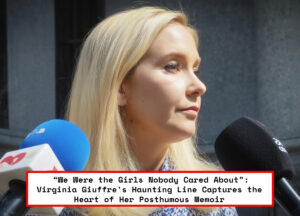
“We Were the Girls Nobody Cared About”: Virginia Giuffre’s Haunting Line Captures the Heart of Her Posthumous Memoir
In the pages of her posthumous memoir, Nobody’s Girl: A Memoir of Surviving Abuse and Fighting for Justice, Virginia Roberts Giuffre confronts readers with a single, piercing sentence that distills years of pain into devastating clarity: “We were girls who no one cared about.” Those seven words stand as one of the most raw and unforgettable moments in the book, encapsulating the profound invisibility and disposability that marked the early stages of her exploitation within Jeffrey Epstein’s trafficking network.
The line arrives without warning, stripped of any softening context or literary flourish. It is not a dramatic flourish crafted for emotional impact; it is the quiet, matter-of-fact realization of a teenager who recognized—perhaps for the first time—that her worth, her safety, and her very existence held no value in the eyes of the adults who should have protected her. Giuffre uses it to describe not just herself but the other young women and girls drawn into the same orbit: vulnerable, often from troubled backgrounds, easily dismissed as runaways, troublemakers, or simply invisible. In the world Epstein and his enablers inhabited, these girls were not seen as individuals deserving of care or concern; they were commodities, expendable and replaceable.
The memoir refuses to let that dismissal stand unchallenged. Giuffre reconstructs the grooming process with unflinching detail—how initial promises of opportunity morphed into coercion, how small favors became obligations, how the illusion of care was weaponized to secure compliance. She writes of being told she was special, chosen, lucky—phrases designed to mask the reality that she and the others were selected precisely because they were believed to be powerless, voiceless, and unlikely to be believed if they ever spoke out. “We were girls who no one cared about” becomes both accusation and indictment: a condemnation of the systems—family, school, law enforcement, society—that failed to notice, failed to intervene, and failed to care when the signs were there.
What makes the statement so devastating is its simplicity. It requires no elaboration to convey the depth of abandonment. It strips away excuses, rationalizations, and the comforting distance that powerful people often place between themselves and the consequences of their actions. In Giuffre’s telling, the lack of care was not accidental; it was foundational. It enabled the abuse to continue unchecked for years, protected by money, connections, and the convenient fiction that these girls somehow brought their circumstances upon themselves.
Yet the memoir is not defined by despair. That single line, brutal as it is, serves as a pivot point. Having been the girl no one cared about, Giuffre transformed that invisibility into visibility. She refused the role of permanent victim. Through lawsuits, public statements, interviews, and now this book, she forced the world to see what had been deliberately ignored. The same society that once looked away is now compelled to look directly at the faces, the names, and the stories of those it failed. Her words reclaim agency: if no one cared then, she would make them care now.
Published after her tragic death in April 2025, Nobody’s Girl carries the additional weight of finality. Giuffre knew she might not live to see full accountability, so she wrote with urgency and precision, ensuring her testimony would outlast her. The line “We were girls who no one cared about” is more than a reflection on the past; it is a challenge to the present and a demand for the future. It insists that indifference is no longer an option, that vulnerability must be met with protection rather than exploitation, and that every girl who has been dismissed as unimportant deserves to have her story heard.
In that one sentence, Virginia Giuffre summarized both the depth of her suffering and the strength of her resistance. It is a heartbreaking admission of what was stolen from her and countless others—and an unbreakable declaration that she would never again allow herself or her truth to be treated as though it did not matter.
Leave a Reply