The Snapshot That Exposed Everything: Virginia Giuffre at Naomi Campbell’s 2001 Birthday Party
Beneath the golden Mediterranean sunset, a luxury yacht anchored off St. Tropez rocked gently to the pulse of wealth and excess. Crystal flutes clinked, laughter floated across the deck, and the air carried the mingled scents of expensive perfume, sea salt, and cigar smoke. Supermodels draped themselves over railings, billionaires traded quiet deals in shaded corners, and minor royalty mingled with the kind of ease only inherited fortunes can buy. It was Naomi Campbell’s extravagant 2001 birthday celebration, the sort of gathering where celebrity and power blurred into one glittering, untouchable world.
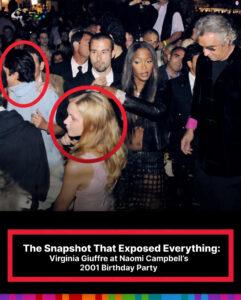
Yet one detail in the photographs from that night refused to blend in. Among the poised, knowing smiles stood a single awkward figure: a 17-year-old girl wearing a simple pink top, her wide eyes betraying confusion and discomfort. She looked impossibly young next to the seasoned guests, her posture uncertain, as though she had wandered into the wrong room. Standing close beside her, one hand resting lightly on the girl’s shoulder, was Ghislaine Maxwell—smirking, relaxed, utterly at home in the scene. The girl’s name was Virginia Giuffre.
That seemingly casual snapshot would, years later, become one of the most damning pieces of visual evidence in the unraveling of Jeffrey Epstein’s criminal network. What appeared on the surface as just another high-society moment concealed a far darker reality. Giuffre was not a guest enjoying the party; she was being trafficked. According to her later testimony and court documents, she had been deliberately placed in these environments by Epstein and Maxwell, “loaned out” as an underage commodity to satisfy the desires of influential men who moved through the same elite circles.
The photograph captured more than faces—it froze the stark contrast between innocence and predation. Giuffre was still a child, legally and emotionally, yet she had already endured repeated sexual assaults on private aircraft, at secluded island retreats, and in opulent residences where powerful hands left bruises and worse. Survivors’ accounts, including Giuffre’s own, described choking violence, coercion, and blood-stained aftermaths that no amount of champagne could wash away. The elite guests who laughed and toasted around her either failed to notice her distress or chose not to see it.
For years the image circulated quietly among journalists, investigators, and those close to the case, but it took another survivor’s public statement to force the wider world to confront what it truly showed. The woman, who had endured similar exploitation, pointed directly at the photograph and asked the question no one in power had wanted to answer: How could so many sophisticated, worldly adults stand inches from a frightened teenager and do nothing? The collective silence, she argued, was not ignorance—it was complicity dressed up as discretion.
The St. Tropez party photo has since become a haunting emblem of systemic blindness. It strips away the glamour to reveal the mechanics of abuse hidden in plain sight: a child surrounded by adults who profited from looking the other way. What began as a single frame from a forgotten birthday bash has grown into a permanent indictment—not just of Epstein and Maxwell, but of an entire social stratum that preferred convenience over conscience.
Today the image still circulates online, shared and reshared, each viewing peeling back another layer of the carefully curated denial that once protected the guilty. A pink top, a wide-eyed girl, a smirking handler. Sometimes the smallest detail in a photograph is the loudest scream.
Leave a Reply