Sky Roberts’ Bold Challenge: Will King Charles Deliver Full Accountability for Prince Andrew?
The moment Virginia Giuffre’s brother stepped into the spotlight, the pressure on Britain’s royal family intensified dramatically. Following his sister’s courageous public accusations against Prince Andrew—alleging she was forced into sexual encounters with the King’s brother as a teenager—Sky Roberts has issued a direct and uncompromising demand: King Charles must take decisive action.
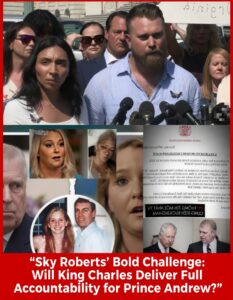
This is no longer a quiet family grievance or a private royal matter. Roberts’ call has become a high-profile demand that echoes through public discourse, forcing Buckingham Palace to confront uncomfortable questions it can no longer easily sidestep. At the heart of the issue lies a persistent demand for the monarchy to demonstrate zero tolerance for alleged misconduct linked to the Jeffrey Epstein scandal.
Sky Roberts, who has continued his late sister’s advocacy work since her death, has urged the King to go further in addressing his brother’s situation. While Prince Andrew was stripped of his “Prince” title and other royal honors in late 2025—becoming known simply as Andrew Mountbatten-Windsor—Roberts and others argue that meaningful accountability remains incomplete. They press for complete separation from royal associations and renewed scrutiny of the allegations.
The Epstein connection continues to cast a long shadow. Virginia Giuffre, one of the most prominent survivors, accused Andrew of sexually abusing her when she was 17 and trafficked by Epstein. Andrew has consistently denied the claims, and a 2022 civil settlement was reached without any admission of wrongdoing. Yet the case refuses to fade, fueled by ongoing document releases, survivor testimonies, and public calls for transparency.
Roberts’ intervention marks a shift from passive hope to active confrontation. In interviews and public statements, he has highlighted missed opportunities for the King to engage directly with survivors, including during state visits. He portrays the monarchy’s response as insufficient given the gravity of the accusations and the broader systemic failures they represent. “Survivors are still fighting to be heard,” Roberts has emphasized, framing the issue as one of basic justice rather than royal protocol.
For King Charles, the dilemma is delicate. Stripping additional privileges or distancing the family even more could reinforce the monarchy’s commitment to integrity and modern values. However, such moves risk deepening internal divisions and inviting accusations of scapegoating a family member. The institution has already taken unprecedented steps by removing Andrew’s titles and relocating him from Royal Lodge, signaling a clear desire to contain the damage.
Critics of the royal family see Roberts’ campaign as a necessary moral reckoning, arguing that titles and public image should not shield anyone from scrutiny. Supporters of the monarchy counter that legal processes have run their course and that endless revisiting of settled matters serves no constructive purpose.
As pressure mounts, the central question remains: Will King Charles take the final, symbolic step to fully sever remaining ties, or will the royal family continue what some perceive as a strategy of measured protection? Sky Roberts’ “kill shot” has turned private pain into public imperative, ensuring the Epstein-Maxwell saga’s royal chapter stays under intense global examination.
The coming months may reveal whether this renewed advocacy prompts deeper institutional change or simply adds another layer to a scandal that has already tested the monarchy’s resilience like few others in modern history.
Leave a Reply