Shattering the Official Story: Rosanna Arquette’s Defiant Doubts About Virginia Giuffre’s Death
When Rosanna Arquette shook her head and stated flatly, “I do not—I don’t believe Virginia Giuffre killed herself,” the polished official narrative fractured. In that single, unwavering moment, what had been reported as a tragic suicide transformed into a resounding cry of suspicion—one that reverberates through every unexplained death linked to Jeffrey Epstein’s vast and shadowy network.
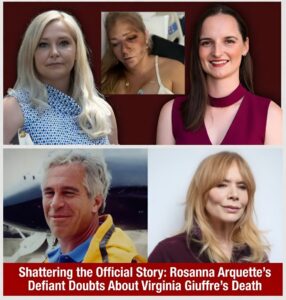
Arquette, a close friend of Giuffre, refused to accept the straightforward explanation. Virginia Giuffre, the woman who had courageously confronted unimaginable evil and exposed one of the most powerful abuse rings in modern history, was found dead in April 2025 at her farm in Western Australia. Her family confirmed the cause as suicide, noting the lifelong toll of trauma from years of sexual abuse and trafficking. Yet Arquette’s public rejection of that conclusion has ignited fresh questions and renewed scrutiny.
“I knew Virginia,” Arquette told interviewers. Her words carry the weight of personal knowledge and shared conversations with Giuffre and other Epstein survivors. To her, the idea that Giuffre—fierce, resilient, and committed to her fight for justice—would choose to end her life did not align with the woman she knew. Instead, Arquette’s stance suggests something far more sinister: elimination rather than despair. If she is correct, the protective layers shielding Epstein’s influential associates may run deeper and more lethal than previously imagined.
This doubt strikes at the heart of a pattern. Epstein’s own death in 2019 was officially ruled a suicide amid widespread skepticism. Other figures connected to the scandal have met untimely ends under circumstances that fuel conspiracy theories. Giuffre’s passing, coming after she continued advocating through her posthumously published memoir Nobody’s Girl, adds another layer to the unease. Survivors and supporters see her final command—“Full truth, no hiding, complete accountability”—as a rallying cry that someone powerful might have wanted silenced.
Arquette’s refusal to accept the easy narrative has amplified the voices of Giuffre’s family members and fellow survivors who also seek further investigation. It challenges authorities and the public to look beyond surface conclusions, especially when powerful interests could benefit from closure. The Epstein web has long been defined by wealth, influence, and strategic silence; questions about Giuffre’s death threaten to pull back that curtain even further.
Her friend’s bold declaration lights a new fire under the movement Giuffre built. What began as collective grief has hardened into unrelenting determination. Survivors refuse to let her story fade or be neatly packaged as a simple tragedy. Instead, they channel suspicion into sustained pressure for transparency—demanding unredacted files, deeper probes, and real consequences for those who enabled or covered up the abuse.
Whether Arquette’s instincts prove correct or not, her statement underscores a broader truth: the Epstein saga is far from over. The shadows protecting that network appear darker and more dangerous with every unresolved question. Virginia Giuffre may no longer speak, but through friends like Rosanna Arquette and the survivors carrying her torch, her demand for complete accountability echoes louder than ever—turning suspicion into an unstoppable force for truth.
Leave a Reply