Julia Roberts Just Proved Vulnerability and Power Can Coexist Beautifully
In Luca Guadagnino’s gripping psychological thriller After the Hunt (2025), Julia Roberts delivers a performance that quietly redefines what strength looks like for a woman in her late 50s. At 58, she plays Yale philosophy professor Alma Imhoff — a character armored in intellect yet unraveling under the weight of moral ambiguity, buried trauma, and fractured loyalties. Through subtle gestures, tight smiles, and moments of raw emotional exposure, Roberts proves that vulnerability and power are not opposites. They can coexist beautifully, creating a magnetism that feels both deeply human and profoundly commanding.
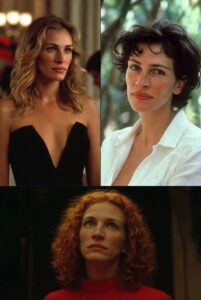
This duality has always been present in Roberts’ work, but it has matured into something luminous with time. Early in her career, her warmth and that famous, head-thrown-back laugh made her America’s Sweetheart in Pretty Woman. Later, her fierce portrayal of Erin Brockovich showed a different kind of power — unapologetic and relentless. Yet in After the Hunt, she allows both sides to breathe simultaneously. Alma is brilliant and composed on the surface, but beneath lies uncertainty, fear, and the quiet terror of confronting her own secrets. Roberts doesn’t dramatize the vulnerability; she lets it surface naturally, making the character’s strength feel earned rather than invincible. Critics have praised this “brittle intensity” — a perfect balance of fragility and fortitude that anchors the entire film.
Off-screen, Roberts embodies this same harmony. After achieving massive success early, she made the powerful choice to step back and prioritize family. Marrying Danny Moder in 2002 and raising their three children taught her that true strength includes knowing when to pause. She has spoken openly about aging with “dignity, humor, and serenity,” choosing not to hide behind heavy cosmetic procedures because she wants her children to see real emotions on her face — anger, joy, confusion, and everything in between. This willingness to be seen as fully human is itself an act of power. At the 2026 Golden Globes, her radiant presence in a plunging black Armani gown, warm laughter, and graceful demeanor earned a standing ovation. She appeared both serene and powerfully present.
Roberts’ confidence stems from this integration. She entered Hollywood with little self-assurance, facing criticism in a male-dominated industry. Instead of building walls, she learned to move through vulnerability with grace. Today, she selects roles that challenge her and the audience, refusing to play it safe or chase relevance. This selective approach — saying yes only when she can fully commit — reflects a woman who understands her worth. Vulnerability, in her hands, becomes a source of strength rather than a weakness.
In a culture that often pits softness against power, Julia Roberts offers a refreshing truth: they can enhance each other. Her latest work and life choices show that real authority comes not from hiding cracks but from letting light shine through them. At 58, she is more compelling than ever because she refuses to choose between being strong and being real. She is both — beautifully, powerfully, and unapologetically.
That is the quiet revolution Julia Roberts continues to lead, proving that the most enduring kind of star power is the one that dares to be fully human.
Leave a Reply