Julia Roberts Just Brought an Emotional Depth That’s Missing from Most Films
In an era of spectacle-driven blockbusters, franchise fatigue, and emotionally flattened streaming content, Julia Roberts has delivered something increasingly rare: profound, lived-in emotional truth. Her performance as Yale philosophy professor Alma Imhoff in Luca Guadagnino’s After the Hunt (2025) doesn’t just carry the film — it restores a layer of human complexity that many modern movies seem to have forgotten.
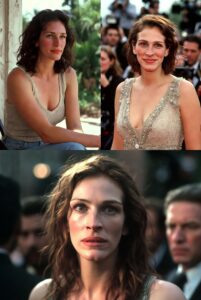
Alma is a woman of intellect and composure who finds herself pulled into a volatile campus sexual assault accusation involving a colleague and a star student. What could have been a straightforward moral drama becomes, in Roberts’ hands, a masterclass in emotional nuance. She plays the role with quiet restraint: a tightened smile that masks doubt, a careful pause heavy with unspoken history, a flicker of vulnerability beneath layers of intellectual armor. There are no sweeping monologues or dramatic breakdowns. Instead, Roberts lets complicated feelings — loyalty, guilt, buried trauma, and moral uncertainty — surface naturally, the way they do in real life. Critics have praised this “brittle intensity,” noting how her performance makes the audience feel the weight of every internal contradiction.
This emotional depth feels especially powerful because it stems from Roberts’ own evolution. After early megastardom in Pretty Woman and her Oscar-winning turn in Erin Brockovich, she intentionally stepped back to raise her three children with Danny Moder. Those years of real-life experience — balancing ambition with motherhood, navigating insecurity, and choosing presence over pressure — now infuse her work with authenticity that younger performers often struggle to access. At 58, Roberts brings the wisdom of someone who has lived fully, not just performed it.
In contrast, many contemporary films rely on heightened drama, rapid cuts, or surface-level messaging. Emotional moments are often reduced to exposition or amplified for maximum impact, leaving audiences moved but not deeply moved. Roberts reminds us that true resonance comes from subtlety. Her ability to convey profound internal conflict through small gestures makes Alma feel achingly human, turning After the Hunt into a film that lingers long after the credits roll.
This depth was visible beyond the screen at the 2026 Golden Globes. Radiant in a plunging black Armani gown, Roberts moved through the evening with warm laughter and genuine presence, earning a standing ovation that celebrated both her career and the woman she has become. She has spoken about embracing aging with “dignity, humor, and serenity,” refusing to hide her real face so her children — and her audience — can witness authentic emotion.
Julia Roberts didn’t need to shout to be heard. By trusting restraint and emotional honesty, she has brought back a richness missing from so much of today’s cinema. In After the Hunt, she doesn’t just act — she reveals. She shows that the most powerful performances aren’t the loudest, but the ones that mirror the quiet complexities of being human.
At a time when many films chase spectacle, Roberts reminds us why we fell in love with storytelling in the first place: to feel deeply, to see ourselves, and to connect with something profoundly real. That gift remains her greatest contribution.
Leave a Reply