Julia Roberts Is Quietly Becoming the Voice a New Generation of Women Needs
At 58, Julia Roberts isn’t shouting manifestos or chasing viral moments. Yet, through her choices, her presence, and her quiet example, she is emerging as the steady, authentic voice millions of women in their 30s, 40s, and beyond have been craving. In a culture saturated with performative empowerment and filtered perfection, Roberts offers something rarer: lived wisdom, unapologetic authenticity, and the courage to define success on your own terms.
Her recent work in Luca Guadagnino’s After the Hunt (2025) perfectly illustrates this shift. As Yale professor Alma Imhoff, Roberts portrayed a complex, morally layered woman navigating power, truth, and personal reckoning. The role wasn’t about glamour or youthful romance—it centered intellectual depth, vulnerability, and quiet strength. Younger women watching her share the screen as an equal with Ayo Edebiri have flooded social media with comments like “Finally, a leading lady who feels like where I’m headed, not where I was.” Roberts isn’t playing the wise elder; she’s modeling a woman fully alive in her own chapter.
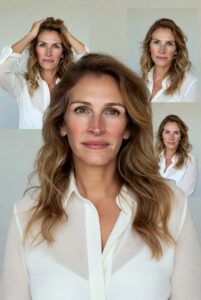
What resonates most is how Roberts lives her values off-screen. She has chosen natural aging with “dignity, humor, and serenity,” rejecting Botox and fillers in an industry that often demands women freeze time. This decision sends a powerful message to a generation exhausted by beauty standards: your worth deepens with time, not diminishes. She speaks openly about wanting her daughter Hazel to see real emotions on her face—laugh lines included—normalizing the idea that a woman’s face should tell her story, not hide it.
Roberts also models boundaries as strength. She fiercely protects her family’s privacy while raising three grounded young adults with Danny Moder. Her rare, heartfelt comments about motherhood—watching her twins turn 21, savoring empty-nest visits, prizing family dinners without phones—feel like gentle permission for women everywhere to prioritize presence over performance. In a world that rewards oversharing, her restraint feels revolutionary.
Younger women are responding because Roberts represents realistic evolution, not endless reinvention. She stepped back at the peak of fame to build a real life, then returned selectively for roles with substance. She mentors emerging talents with genuine warmth. She calls being “a nice person” her proudest achievement. These aren’t trendy slogans—they’re consistent actions that cut through the noise of hustle culture and performative feminism.
In interviews, Roberts emphasizes gratitude rituals, mindful presence, and choosing discomfort for growth—lessons that feel tailor-made for women navigating career pivots, motherhood, aging parents, and self-redefinition. She proves you can be iconic without sacrificing peace, kind without being weak, and powerful without being loud.
Julia Roberts isn’t trying to lead a movement. By simply living with integrity—aging naturally, loving steadily, working thoughtfully, and speaking honestly—she has become the voice a new generation needs: one that whispers, “You don’t have to shrink, perform, or chase. You simply get to become more yourself.” In her quiet confidence, millions of women are finding permission to do the same.
Leave a Reply