Angelina Jolie’s Most Controversial Roles
Angelina Jolie has built a career on bold, edgy, and often provocative roles. While many have earned her critical acclaim, several have sparked significant controversy for reasons ranging from explicit content to casting choices.
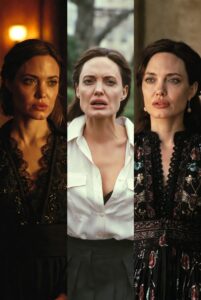
1. Gia (1998)
Jolie’s portrayal of supermodel Gia Carangi in this HBO film is considered one of her breakthrough performances, earning her a Golden Globe. However, it was highly controversial at the time due to its explicit sex scenes, heavy drug use, and open depiction of lesbian relationships. Some critics felt the film glamorized self-destructive behavior, while others praised its raw honesty.
2. A Mighty Heart (2007)
This is perhaps Jolie’s most criticized role for whitewashing. She played Mariane Pearl, a French-born journalist of Afro-Cuban, Chinese, and Dutch descent. Despite Pearl personally approving Jolie for the part, many accused her of cultural appropriation. Critics pointed to the darker makeup and curly wig as problematic, calling it a form of “blackface” in modern cinema. The backlash highlighted Hollywood’s ongoing issues with race and casting.
3. Wanted (2008)
In the comic book adaptation, Jolie played Fox, a character who was African-American in the source material. This casting drew accusations of whitewashing, with many noting the character had been partly inspired by Halle Berry. The film’s graphic violence and sexual content added to its polarizing reception.
4. Original Sin (2001)
Co-starring Antonio Banderas, this erotic thriller featured extremely explicit sex scenes that pushed boundaries for mainstream cinema. Many reviewers dismissed it as “soft-core nonsense,” criticizing Jolie for choosing a role they felt undermined her talent after her Oscar win for Girl, Interrupted.
5. Alexander (2004)
Jolie played Queen Olympias, mother of Alexander the Great, opposite Colin Farrell (who was nearly the same age as her). The film faced heavy criticism for historical inaccuracies, its portrayal of bisexuality, and the awkward mother-son dynamic due to the minimal age gap between the actors.
6. Lara Croft: Tomb Raider (2001 & 2003)
While commercially successful and career-defining, the films were accused of cultural appropriation. Critics argued that the white heroine raiding ancient global treasures reinforced colonialist narratives.
Other roles, such as her villainous turns in the Maleficent films, have drawn milder criticism for character reinterpretation, but the above remain the most debated.
Despite the controversies, these roles often showcased Jolie’s willingness to take risks. Many of them contributed to her transformation from a “wild child” actress into a global star and humanitarian. In retrospect, some controversies reflect changing cultural standards around representation more than the performances themselves.
Leave a Reply