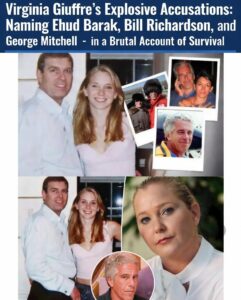
Virginia Giuffre’s Explosive Accusations: Naming Ehud Barak, Bill Richardson, and George Mitchell in a Brutal Account of Survival
Virginia Giuffre did not whisper her allegations—she shouted them into the public record, first through court filings, then in raw interviews, and finally in the pages of her memoir Nobody’s Girl. Among the most shocking claims she leveled were those against three men whose names once carried unimpeachable prestige: former Israeli Prime Minister Ehud Barak, former New Mexico Governor and U.N. Ambassador Bill Richardson, and former U.S. Senator George Mitchell.
In sworn depositions and in her book, Giuffre described an encounter with Ehud Barak that she said left her convinced she would not survive the night. She alleged the assault was so violent—brutal beyond anything she had previously endured—that she believed she was going to die during the attack. She recounted being directed to a location where Barak allegedly waited, the terror of the physical overpowering, the pain that made her fear internal injuries, and the chilling aftermath in which she was left shaken, bleeding, and silenced by threats. Giuffre maintained that the incident was part of a larger pattern of coercion orchestrated by Jeffrey Epstein and Ghislaine Maxwell, who she said arranged and facilitated these encounters for powerful men.
She did not stop there.
Giuffre explicitly named Bill Richardson—then a towering figure in Democratic politics, Nobel Peace Prize nominee, and governor of New Mexico—as another abuser who participated in the trafficking network. She described being trafficked to him on multiple occasions, alleging sexual abuse that occurred under the same coercive framework Epstein employed with other high-profile associates. Richardson, who died in 2023, consistently denied the allegations through spokespeople until his passing; no criminal charges were ever filed against him in connection with Giuffre’s claims.
Similarly, Giuffre identified former Senate Majority Leader George Mitchell—architect of the Northern Ireland peace process, respected statesman, and special envoy under multiple U.S. administrations—as yet another participant. She alleged he too had been trafficked to her by Epstein and Maxwell, describing encounters marked by the same power imbalance and intimidation that defined her years under Epstein’s control. Mitchell issued firm public denials, calling the accusations “completely false” and stating he had never met Giuffre.
These names appeared not in tabloid speculation but in legal documents Giuffre submitted under penalty of perjury, in her memoir’s unredacted passages, and in interviews where she spoke with unflinching clarity. She framed the accusations as part of a broader indictment: a system in which wealth, status, and connections shielded perpetrators while victims were dismissed, discredited, or threatened into silence.
The revelations landed like depth charges. Barak, Richardson, and Mitchell each represented different spheres of global influence—military and diplomatic leadership, American state governance, legislative power—yet Giuffre placed them in the same orbit of exploitation. Defenders pointed to the absence of corroborating criminal convictions; supporters highlighted the pattern of settlements, sealed records, and non-disclosure agreements that had kept similar allegations from full public scrutiny for years.
Giuffre’s words carried a recurring refrain: she was not inventing stories for attention. She was reclaiming a narrative that powerful interests had tried to erase. Her memoir devotes entire chapters to these encounters, supported by timelines, locations, and contextual details drawn from her contemporaneous notes and later legal discovery.
Long after her voice was silenced, those pages remain—open, unredacted, and accusing.
In naming Ehud Barak, Bill Richardson, and George Mitchell, Virginia Giuffre did not merely allege abuse. She mapped a network of impunity. And the map is still being read.
Leave a Reply