Virginia Giuffre’s Account and Trump’s Allegation That Epstein “Took” Her from Mar-a-Lago
Virginia Giuffre, originally named Virginia Louise Roberts and born in 1983 in Sacramento, California, has become one of the most well-known figures among the victims and accusers connected to the Jeffrey Epstein sex-trafficking case. After her family moved to Florida, she faced a challenging upbringing that reportedly included abuse, time spent in foster care, and several instances of running away from home. In her mid-teens, around the summer of 2000 when she was 16, Giuffre obtained employment at Donald Trump’s exclusive Mar-a-Lago resort in Palm Beach, Florida, where she worked as a locker room attendant or in the spa area.
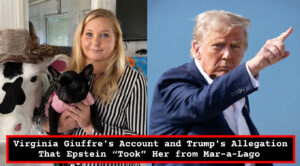
Her path crossed with Jeffrey Epstein’s through an introduction by Ghislaine Maxwell while she was still employed at the resort. According to Giuffre’s accounts, Maxwell approached her at Mar-a-Lago and offered her an opportunity to meet a wealthy financier who could provide financial help and possibly fund her education. This encounter marked the beginning of her involvement in Epstein’s circle, during which she later alleged she was recruited into a sex-trafficking network involving underage girls.
Giuffre has publicly described how she was drawn into Epstein’s world, claiming she was trafficked to high-profile individuals for sexual purposes. Her story gained significant attention when she filed lawsuits and gave interviews detailing her experiences. One particularly notable aspect of her narrative involves former President Donald Trump. Giuffre has stated in court documents and depositions that she first encountered Epstein at Mar-a-Lago, and that Trump knew both her and Epstein during that period. However, she has also clarified that she never witnessed Trump engaging in any illegal sexual activities with minors.
In response to questions about Giuffre and Epstein, Trump has made a specific claim regarding how the two met. He has asserted that Epstein “stole” Giuffre from Mar-a-Lago. Trump has described the situation by saying that Epstein took the young girl away from his property without his knowledge or approval. This statement was part of Trump’s effort to distance himself from Epstein, emphasizing that once he learned about Epstein’s inappropriate behavior toward young women, he banned the financier from Mar-a-Lago.
The claim has sparked discussion and debate among observers. Supporters of Trump view it as evidence that he acted responsibly by cutting ties with Epstein upon discovering his misconduct. Critics, however, point out the close social circles in Palm Beach at the time and question the extent of Trump’s prior association with Epstein. Flight logs and other records show that Trump flew on Epstein’s plane at least once, though not to the private island, and the two men socialized in the 1990s and early 2000s before their relationship reportedly soured.
Giuffre’s experiences have played a central role in exposing the broader Epstein network. She has been instrumental in legal actions against Ghislaine Maxwell and others connected to the case. Her allegations have led to settlements, including one with Prince Andrew, and have continued to fuel public interest in the full scope of Epstein’s operations even years after his death in 2019.
Throughout the years, Virginia Giuffre has maintained her focus on seeking justice for herself and other victims. Her journey from a troubled teenager working at a luxury resort to a prominent voice in one of the most high-profile sex-trafficking scandals highlights the complex and often hidden dynamics of power, wealth, and exploitation. The contrasting narratives surrounding her recruitment—particularly Trump’s assertion that Epstein “stole” her from Mar-a-Lago—continue to be examined as part of the larger effort to understand the events and relationships that allowed Epstein’s crimes to persist for so long.
Leave a Reply