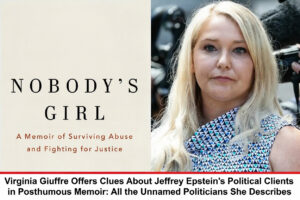
Virginia Giuffre Offers Clues About Jeffrey Epstein’s Political Clients in Posthumous Memoir: All the Unnamed Politicians She Describes
In her posthumous memoir Nobody’s Girl: A Memoir of Surviving Abuse and Fighting for Justice, released in October 2025, Virginia Giuffre provides veiled descriptions of several high-profile individuals she alleges were involved in Jeffrey Epstein’s trafficking network, including unnamed politicians and political figures. Giuffre, who died by suicide in April 2025 at age 41, named some abusers explicitly in prior legal filings and public statements — such as Prince Andrew, with whom she settled a civil lawsuit in 2022 without any admission of liability — but chose to describe others only by their roles or characteristics, leaving readers and investigators to piece together potential identities.
Giuffre wrote that she was “trafficked to a multitude of powerful men” during her time with Epstein and Ghislaine Maxwell, portraying the operation as one where victims were “lent out” to elites for sexual exploitation. Among the political clients she alluded to without naming:
- A gubernatorial candidate who “was soon to win an election in a Western state.” Giuffre described being trafficked to this individual, implying the encounter occurred around the time of his successful campaign for governor.
- A former U.S. Senator. She referenced this figure as one of the men to whom she was “lent out,” part of a pattern involving politicians who benefited from Epstein’s connections.
- A “heralded statesman” she was sent to in both New York and Palm Beach. Described as the oldest man Epstein trafficked her to, this person was portrayed as a respected political leader whose involvement added to the sense of untouchable power surrounding Epstein’s circle.
Additionally, Giuffre detailed a particularly brutal assault by a “well-known Prime Minister” (in the U.S. edition of the memoir) or a “former minister” (in the UK version), whom she accused of beating and raping her savagely. She wrote of fearing she might “die a sex slave” under such treatment and noted discrepancies in regional editions that may stem from legal considerations. Her lawyer has suggested law enforcement already knows the identity based on prior filings.
Giuffre also mentioned being trafficked to a psychology professor whose research Epstein funded, though this figure is more academic than strictly political. Broader references in the book touch on Epstein’s interactions with politicians like Bill Clinton (mentioned in flight logs and social contexts but not accused of abuse by Giuffre) and others, but she emphasized that many participants knew of the exploitation yet “watched and didn’t care.”
The memoir has reignited speculation and calls for full disclosure of Epstein-related evidence, including alleged hidden camera footage that Giuffre claimed captured compromising acts for blackmail. Her stepbrothers, Sky Roberts and Daniel Williams, along with sisters-in-law Amanda Roberts and Lanette Wilson, have amplified these demands, insisting that releasing such materials would reveal the extent of political involvement and deliver justice for survivors.
Giuffre’s careful use of descriptors rather than direct names reflects concerns over safety, legal risks, and potential threats to her family, as noted in coverage of the book. Co-author Amy Wallace has indicated she knows additional details but respects Giuffre’s choices in what to reveal. The book underscores her view that victims “are not born, they are made” through systemic failures and elite impunity, with these political clues serving as a final push for accountability in Epstein’s enduring scandal.
Leave a Reply