They Tried to Erase Her from the Record — But Virginia Giuffre Rewrote Herself into History
They attempted to remove her name from the narrative entirely, to let time and influence quietly scrub away every trace of her existence in their world. But Virginia Giuffre refused erasure. With fierce determination, she seized control of the story they tried to suppress and forced it back into the light—page by painful page, testimony by testimony, revelation by revelation.
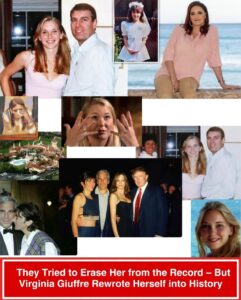
What powerful figures and their networks worked so hard to conceal, she methodically brought to the surface. Hidden connections, secret travel itineraries, whispered encounters in private estates and remote islands—details they had counted on remaining buried—she unearthed and placed squarely in the public domain. What they dismissed as fantasy or exaggeration, she countered with documented evidence: court filings, flight logs, sworn statements, and her own meticulously kept records that refused to stay silent.
Her truth has become their greatest liability. Every denial they issued, every effort to discredit her, every legal maneuver designed to intimidate or marginalize only strengthened the case she built. The more they pushed back, the clearer the pattern became: a system engineered to protect privilege at the expense of the vulnerable. Giuffre’s persistence turned their attempts at containment into proof of complicity. Her survival became their exposure.
In her own words, she transformed suffering into strength. “My pain became my weapon,” she declared—a statement that captures the alchemy at the heart of her fight. The trauma inflicted upon her did not break her into submission; instead, it forged a tool of accountability. She took the agony they caused and redirected it, using it to dismantle the very illusions of untouchability they had cultivated for decades.
Her memoir, Nobody’s Girl, stands as the ultimate defiance. Those pages contain the accounts they desperately wanted suppressed—the names, the dates, the locations, the moments they believed would never see daylight. They urged the world to look away, to move on, to accept convenient versions of events. Giuffre refused. She insisted the public read what had been hidden, confront what had been denied, and reckon with what had been enabled.
The impact ripples outward still. Survivors find validation in her refusal to be silenced. Institutions once shielded by prestige now face renewed scrutiny. Conversations that were once taboo are now unavoidable. What began as one woman’s battle for recognition has grown into a broader demand for justice, transparency, and reform.
They thought history could be rewritten without her consent. They were wrong. Virginia Giuffre wrote herself back into the record—not as a footnote or a cautionary tale, but as the central figure whose courage exposed the rot beneath polished surfaces. Her story is no longer theirs to control or contain. It belongs to the truth she fought to preserve, and to every person who now refuses to look away.
The pages they begged the world to ignore are open. The words they feared are being read. And the undoing they never anticipated is well underway—because one survivor decided that being erased was never an option.
Leave a Reply