The 2022 Settlement That Didn’t End the Questions: Prince Andrew, Virginia Giuffre, and the Lingering Shadow of Epstein
In February 2022, one of the most closely watched civil lawsuits in recent royal history came to an abrupt close. Prince Andrew, Duke of York, reached an out-of-court settlement with Virginia Giuffre, bringing an end—at least legally—to her claims that he had sexually assaulted her as a teenager. The agreement, reportedly involving a multimillion-pound payment, allowed both parties to avoid the risks and revelations of a full trial in a New York federal court.
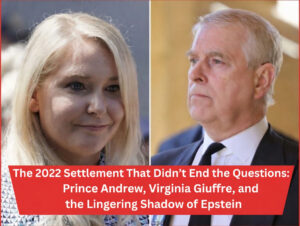
Giuffre’s allegations were stark and specific. She asserted that Jeffrey Epstein had trafficked her as a minor and orchestrated sexual encounters with influential men, including three separate incidents with Prince Andrew in 2001: once at Epstein’s Manhattan townhouse, once in London, and once on Little St. James, Epstein’s private island in the U.S. Virgin Islands. These claims formed part of a broader pattern she described in multiple legal filings, interviews, and eventually her posthumous memoir—accounts of a world where power insulated perpetrators and silenced victims for years.
Prince Andrew, for his part, has always categorically denied the accusations. In public statements and during his widely scrutinized 2019 BBC Newsnight interview, he insisted he had no memory of ever meeting Giuffre, offered explanations for a widely circulated photograph showing him with his arm around her waist (with Ghislaine Maxwell in the background), and maintained that he had no knowledge of—or participation in—Epstein’s criminal conduct. He described his association with Epstein as a regrettable but limited friendship from an earlier period.
The settlement itself contained no admission of liability on Andrew’s side. Court documents noted that the payment was made “in recognition of the distress Ms. Giuffre has suffered,” and both parties expressed a desire to move forward. Giuffre later stated publicly that the resolution allowed her to focus on supporting other survivors and continuing her advocacy work. For Andrew, the agreement removed the immediate threat of depositions, cross-examinations, and potentially damaging disclosures under oath.
Yet the financial and reputational fallout proved enduring. Reports surfaced suggesting that Queen Elizabeth II contributed toward the settlement sum, though Buckingham Palace never officially confirmed the amount or source. Andrew was stripped of his military titles, royal patronages, and use of the style “His Royal Highness” for public duties in early 2022—measures that remained in place long after the case concluded. Public opinion remained deeply divided: some viewed the settlement as pragmatic damage control; others saw it as further evidence of institutional protection for the powerful.
Virginia Giuffre’s voice, however, never fully receded. Even after the 2022 resolution, she continued speaking publicly about systemic failures, the need for accountability, and the experiences of survivors within Epstein’s network. Her posthumous memoir, published after her death in April 2025, revisited these events with unflinching detail, reigniting scrutiny of the settlement’s terms, the funding behind it, and the broader questions it left unanswered.
More than three years later, the 2022 agreement stands less as a final chapter and more as a pause in an ongoing conversation. For many, it resolved a legal dispute without resolving the deeper issues of transparency, justice, and institutional responsibility. The settlement closed one courtroom door—but opened others in public discourse, survivor advocacy, and renewed demands for answers that no financial agreement could fully silence.
Leave a Reply