Netflix Unveils a Story of Power, Silence, and Truth: Virginia Giuffre’s Testimony Reignites Scrutiny in Explosive Four-Part Docuseries
Netflix’s new four-part docuseries arrives as a unflinching examination of power, engineered silence, and the enduring force of truth. At its center stands Virginia Giuffre’s powerful story—her testimony, once marginalized and met with skepticism, now positioned as the catalyst that has reignited intense public scrutiny into one of the most controversial and unresolved cases of the past decade.
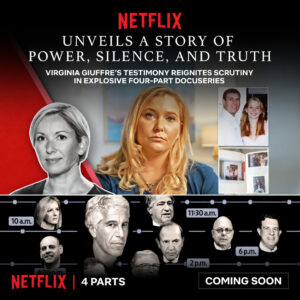
The series opens without preamble or gloss. It begins with Giuffre’s own voice—archival clips of a young woman recounting the grooming that started at age 15, the promises that masked coercion, and the calculated immersion into Jeffrey Epstein’s web of exploitation. From there, the narrative unfolds with deliberate precision across four episodes, each building on the last to reveal not just individual acts of abuse but the broader systems that enabled, concealed, and prolonged them.
Viewers are taken through the physical and institutional landscapes that defined the saga: the heavily secured Manhattan townhouse where privacy shielded alleged encounters; the remote, fortified Little St. James island, a place of isolation designed to amplify control; the private jets and elite networks that normalized what should have been unthinkable. Giuffre’s specific allegations against Prince Andrew—three encounters in 2001 described with consistent detail—are revisited not for sensationalism but to illustrate patterns of entitlement, access, and impunity.
The docuseries excels in its refusal to rush or dramatize. It lets evidence speak: cross-referenced flight logs, unsealed court filings, redacted documents slowly contextualized, survivor statements aligned in timeline. It examines the 2015 defamation suit against Ghislaine Maxwell, the 2022 civil settlement with Prince Andrew, and the persistent questions that settlement left unanswered—questions about funding sources, non-disclosure pressures, and the institutional reluctance to pursue full transparency.
Giuffre’s transformation from silenced victim to public advocate forms the emotional core. The series traces her shift: from private pain to legal filings, from isolation to alliances with other survivors, from guarded disclosures to unflinching public testimony. Family voices—stepbrother Sky Roberts, his wife Amanda, and others—offer intimate glimpses of the woman behind the headlines: a protective sister, a devoted mother, a fighter who balanced fierce determination with the quiet toll of unrelenting trauma.
The final episode confronts the legacy. It addresses Giuffre’s relocation to Western Australia, her ongoing advocacy, the cumulative weight that contributed to her suicide in April 2025 at age 41, and the posthumous publication of her memoir. It shows how her disclosures—once confined to courtrooms or dismissed in certain circles—now fuel renewed demands: for complete document releases, for accountability without expiration dates, for recognition that survivor voices deserve more than partial acknowledgment.
Netflix’s approach is stark and powerful—no celebrity narration, no manipulative music cues, minimal editorial overlay. By centering Giuffre’s words and the raw accumulation of facts, the series transforms what was once a story of containment into one of unavoidable confrontation. It demonstrates how one woman’s testimony, amplified rather than diluted, can crack open long-protected narratives and force the public to ask questions that power once hoped would fade.
This docuseries does not merely recount history. It revives it. Virginia Giuffre’s story—once pushed to the edges—now stands at the center, a catalyst that continues to drive scrutiny, conversation, and the slow, necessary erosion of silence. In four parts, Netflix has made clear: some truths, once spoken, refuse to be reburied.
Leave a Reply