Newly unsealed emails from Jeffrey Epstein’s estate, released in November 2025 by the House Oversight Committee, have reignited scrutiny of Donald Trump’s past associations with the convicted sex offender. In a 2011 exchange with Ghislaine Maxwell, Epstein wrote that a victim—identified by sources across the political spectrum as Virginia Giuffre—had “spent hours at my house” with Trump, whom he called the “dog that hasn’t barked,” implying Trump remained silent amid emerging allegations. Epstein noted Trump “has never once been mentioned” in connection with scandals, despite the alleged time spent together.
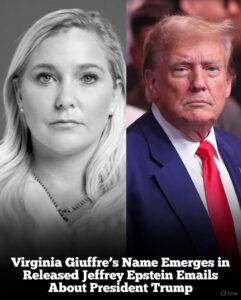
These messages, part of over 23,000 documents subpoenaed from Epstein’s estate, surfaced amid partisan battles. Democrats highlighted them to question Trump’s proximity to Epstein’s world, while Republicans countered by revealing the redacted victim’s name as Giuffre, emphasizing her repeated statements exonerating Trump. White House officials described the selective release as a “smear” tactic, pointing out that Giuffre, Epstein’s most prominent accuser, never implicated Trump in wrongdoing.
Giuffre, recruited by Maxwell at age 16 while working at Trump’s Mar-a-Lago resort in 2000, consistently maintained in depositions, interviews, and her posthumous memoir Nobody’s Girl that Trump was uninvolved. In a 2016 deposition, she stated, “I don’t think Donald Trump participated in anything,” and described limited interactions as friendly but innocuous. She recalled meeting Trump through her father, a Mar-a-Lago employee, but denied witnessing or experiencing any misconduct from him. Her accounts aligned with Maxwell’s testimony and other records: no corroboration of abuse involving Trump emerged.
Trump has long distanced himself, claiming he banned Epstein from Mar-a-Lago after learning of his behavior toward female staff, including poaching young employees like Giuffre. He denied deeper involvement, calling the emails a politically motivated “hoax.”
Giuffre’s bravery defined her legacy. Escaping Epstein in 2002, she built a family in Australia, founded advocacy groups for survivors, and pursued justice, contributing to Maxwell’s 2021 conviction. Yet the enduring trauma proved overwhelming. On April 25, 2025, at age 41, Giuffre died by suicide on her Western Australian farm, amid personal struggles including health issues and family challenges. Her relatives described the “toll of abuse” as unbearable, honoring her as a “fierce warrior” who lifted countless survivors.
The emails underscore Epstein’s manipulative web but add no new evidence against Trump, per Giuffre’s unwavering testimony. They serve as a somber reminder of survival’s profound costs, ensuring Giuffre’s voice—clear, resolute, and unyielding—endures beyond the shadows.
Leave a Reply