Chicago Mayor Brandon Johnson Calls for UN Probe into U.S. Immigration Enforcement, Labels It a “Human Rights Crisis”
In a bold and highly unusual move, Chicago Mayor Brandon Johnson appeared before the United Nations Human Rights Council in Geneva and formally urged the international body to investigate United States immigration enforcement practices, which he described as a full-scale “human rights crisis.”
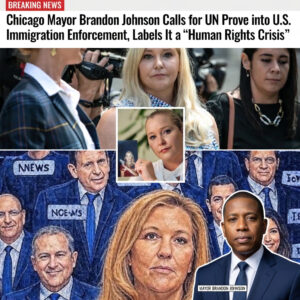
Speaking directly to the Council, Johnson singled out recent federal operations—including the high-profile effort known as Operation Midway Blitz—as “abusive” and “inhumane.” He accused the federal government of employing tactics that violate basic human dignity, disproportionately target vulnerable communities, and erode trust between local law enforcement and the residents they serve.
“These are not isolated incidents,” Johnson stated. “This is a pattern of systemic abuse that demands international scrutiny. When families are torn apart, when children are traumatized, and when entire neighborhoods live in fear of raids, we are no longer talking about border security—we are talking about a humanitarian emergency on American soil.”
The mayor used the global platform to reaffirm Chicago’s long-standing identity as a “Welcoming City.” He explicitly declared that city resources—shelters, public schools, municipal buildings, health clinics, and other local facilities—will not be made available to assist federal immigration enforcement actions or raids. “Chicago will continue to protect the safety and dignity of every resident, regardless of immigration status,” he emphasized. “We will not cooperate with efforts that criminalize our neighbors or turn our public institutions into tools of fear.”
Operation Midway Blitz, the specific initiative Johnson highlighted, has drawn sharp criticism since its launch. Reports describe it as a coordinated, multi-agency sweep targeting undocumented individuals in sanctuary jurisdictions, involving increased workplace raids, traffic checkpoints, and community-level enforcement actions. Critics, including immigrant-rights organizations, have alleged excessive force, family separations without due process, and intimidation tactics that echo earlier controversial operations.
Johnson’s decision to take the issue directly to the United Nations marks one of the most aggressive stances yet by a major U.S. city leader against federal immigration policy. While mayors have long declared sanctuary policies and limited cooperation with ICE, elevating the matter to the Human Rights Council represents an extraordinary escalation, inviting international attention and potential diplomatic repercussions.
The speech has already sparked polarized reactions. Supporters praise Johnson for defending vulnerable populations and holding federal authorities accountable on a world stage. Critics, including some federal officials and conservative commentators, accuse him of overstepping municipal authority, undermining national sovereignty, and politicizing local governance at the expense of public safety.
Regardless of perspective, the mayor’s appearance in Geneva has thrust Chicago’s “Welcoming City” commitment into the global spotlight. By refusing to lend local infrastructure to federal enforcement and calling for UN-level investigation, Johnson has drawn a clear line: in Chicago, protecting residents from what he calls inhumane practices takes precedence over cooperation with Washington.
As the Human Rights Council deliberates whether to take up the matter, the episode underscores deepening tensions between local sanctuary jurisdictions and federal immigration priorities. For now, the mayor’s message is unequivocal—Chicago will not be a silent partner in what he views as a moral and humanitarian failure.
Leave a Reply