In a stunning holiday-season revelation that has sent shockwaves through Hollywood and beyond, Brett Ratner—the filmmaker behind blockbuster hits like the Rush Hour series and X-Men: The Last Stand—has appeared in newly released portions of the Jeffrey Epstein files. The connection, emerging around Christmas 2025 and continuing into early 2026 releases by the U.S. Department of Justice, has left industry insiders stunned and online speculation running rampant.
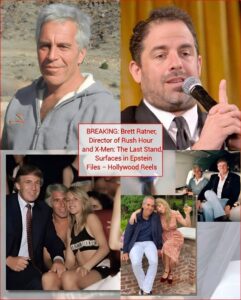
The leaked and unsealed materials—part of massive document dumps totaling millions of pages, images, and videos under the Epstein Files Transparency Act—include photographs showing Ratner in social settings with Epstein himself. One widely discussed image depicts Ratner seated on a sofa, arm around an unidentified woman (whose face is redacted), positioned next to Epstein and another obscured woman. Additional photos place him alongside Epstein associate Jean-Luc Brunel, a modeling agent later accused of serious crimes. These images surfaced amid broader releases that also named other high-profile figures, but Ratner’s presence hit especially hard given his Hollywood pedigree.
Ratner, who has faced prior sexual misconduct allegations (which he denies) that largely sidelined him during the #MeToo era, quickly responded to the photos. He stated he had no personal relationship with Epstein, claiming he met him only once at an event roughly 20 years ago. He identified the woman he was embracing as his then-fiancée, emphasizing the photo captured a casual moment unrelated to any wrongdoing. “I didn’t know him,” Ratner insisted in interviews, calling the renewed scrutiny “crazy” and “horrible.”
The timing amplified the impact. Just as Ratner was attempting a high-profile comeback—directing the documentary Melania about the former First Lady, backed by influential figures—the Epstein files resurfaced his name at a moment when public attention was already laser-focused on unresolved questions from Epstein’s network. No accusations of criminal involvement have been leveled against Ratner in connection with Epstein; the photos appear to document social overlap rather than direct participation in crimes. Still, the visual evidence has fueled endless questions: Is this merely a coincidental brush with a notorious figure, or does it hint at deeper ties within elite circles?
Hollywood remains on edge. Whispers among executives and agents reflect anxiety over reputation management in an industry still grappling with accountability. Online, netizens have dissected every detail—comparing timelines, scrutinizing redacted faces, and debating whether this is another layer of the Epstein saga or just guilt by association.
The files themselves are incomplete and heavily redacted in places, leaving much open to interpretation. The Justice Department has emphasized that inclusion in these records does not imply wrongdoing, as many entries stem from investigations, tips, or social documentation rather than evidence of crimes. Yet in a world where perception often outpaces facts, one name in the Epstein files is sometimes enough to ignite a firestorm.
Whether this proves to be a fleeting controversy or the start of renewed scrutiny for Ratner, the episode underscores a persistent truth: the shadow of Jeffrey Epstein continues to reach into the highest levels of power and fame, and no release of documents has yet fully closed the book.
Leave a Reply